Interior designer Utrecht: where medieval grandeur and timeless refinement meet
A city that has preserved its medieval heart, yet simultaneously pulsates with contemporary energy—that's Utrecht. The Dom Tower towers above the city skyline, the wharf cellars are reflected in the water of the Oudegracht canal, and stately mansions border innovative architecture. In this unique combination of centuries, styles, and scales, every interior demands an interior designer who understands both the depth of history and the power of the present.
As an interior designer in Utrecht, I create spaces that leave nothing to chance. Interiors where the historical fabric of the city is embraced rather than ignored. Where contemporary life finds its place without disrupting the soul of the building. Where silence is possible, even in the heart of one of the most dynamic cities in the Netherlands.

The Essence of living in Utrecht
Utrecht possesses a unique intimacy that other large cities lack. The compact city center, the human scale of the buildings, the presence of water and greenery among the buildings: it creates a living environment unlike that of Amsterdam, The Hague, or Rotterdam.
This calls for interiors that respect this intimacy. Spaces that are warm and inviting, that connect with the atmosphere of the city beyond its walls. But at the same time, there are spaces that surprise, that go beyond expectations, that demonstrate that luxury and refinement are not incompatible with Utrecht's down-to-earth approach.
In my work as an interior designer, I always begin by listening. To the client, but also to the building itself. The way light falls through a 15th-century window. The proportions of a room in a 19th-century mansion. The acoustics of a renovated warehouse. Every building speaks, if you are willing to listen.
The Oudegracht and its surroundings: living at a unique depth
The Oudegracht is undoubtedly Utrecht's most iconic feature. Its unique dual structure—street at ground level, path at canal level—has led to a building structure found nowhere else in the world: the wharf cellars.
The wharf cellars: from storage space to exclusive living space
What once served as storage for goods from merchant ships is today one of the most coveted residential locations in the Netherlands. The raw brick vaults, the small windows at water level, the stone floor: elements that form a powerful foundation for a contemporary interior.
For an interior designer, it's all about balance. Preserving the raw authenticity of the Middle Ages—the irregular walls, the vaults, the robust materials—while adding a level of comfort and refinement befitting the high-end segment. Warm lighting that enlivens the brick. Soft textures that contrast with the cold stone. Custom-made furniture that fully utilizes the irregular space.
Light as both a challenge and an opportunity
The limited natural light in wharf cellars calls for a well-thought-out lighting design. Natural light is maximized through reflective materials and strategically placed mirrors. Artificial lighting is built up in layers: warm ambient lighting, accent lighting on architectural details, and mood lighting that transforms the space with the time of day.
The result is spaces that have an intimate character during the day and glow magically in the evening—completely in keeping with the unique atmosphere of Utrecht's canals.

Historische herenhuizen en stadspaleizen
Naast de Oudegracht herbergt Utrecht een indrukwekkende collectie historische herenhuizen, kapitale panden aan singels en brede straten, en voormalige kerkgebouwen die zijn omgezet naar woonfunctie. Dit zijn ruimtes met grandeur — hoge plafonds, brede trappenhuizen, monumentale schoorstenen — die om een corresponderende aanpak vragen.
Het eer bewaren van het originele vakmanschap
Stucwerkplafonds, houtgesneden betimmeringen, originele tegelvloeren, gietijzeren trapleuningen: elk van deze details draagt een verhaal. Als binnenhuisarchitect is het mijn eerste taak om te inventariseren wat er is, wat bewaard moet worden, en wat gerestaureerd dient te worden.
Dit is zorgvuldig werk, in samenwerking met gespecialiseerde restaurateurs en ambachtslieden die weten hoe men een Lodewijk XVI-stucwerkplafond herstelt of een 18e-eeuwse parketvloer opnieuw in ere stelt. Het resultaat is een interieur dat zijn leeftijd draagt met gratie, niet als museum maar als levende woning.
Hedendaagse luxe in historische kaders
Een monumentaal Utrechts herenhuis vraagt tegelijkertijd om voorzieningen die het hedendaagse leven comfortabel maken. Een keuken die als hart van het huis fungeert. Een badkamer die een persoonlijk wellness-ritueel mogelijk maakt. Geïntegreerde technologie die onzichtbaar blijft maar onmisbaar is.
Dit vraagt om architectonisch vakmanschap: slimme ingrepen die de historische structuur respecteren maar er iets nieuws aan toevoegen. Een moderne keuken verborgen achter klassieke kasten. Een grote inloopdouche ingebouwd in wat ooit een dressing was. Klimaatbeheersing die onzichtbaar is geïntegreerd in de bestaande constructie.
Utrecht in the 20th century: stylish spaciousness
Beyond its historic city center, Utrecht also boasts a wealth of 20th-century architecture. From the expressive Dudok apartment building to the stately villas in Tuindorp and Wilhelminapark, from modernist apartment blocks to contemporary new construction projects: each requires its own unique approach.
Villas in Wilhelminapark and the residential area
The more spacious residential areas surrounding Utrecht offer a different world. Detached villas with expansive gardens, garages with high ceilings, modern extensions to historic cores: here, there's more physical space, but the task is no less complex.
The challenge lies in creating a cohesive interior that honors the scale of the space. Large rooms can feel cold and impersonal if not well-designed. The art lies in creating intimacy within grandeur, through zoning, use of materials, and furnishings that define spaces without diminishing them.
Transformed industrial buildings
Utrecht also boasts a growing number of transformed commercial buildings, former office buildings, and industrial sites converted into homes. The Merwedekanaalzone and other redevelopment areas offer a new type of living space: high ceilings, large industrial windows, and robust construction.
Here, the possibilities are different than in historic buildings. Capitalizing on openness. Embracing material contrasts. Defining spaces within an open landscape. The result is interiors that honor the industrial heritage while adding a contemporary refinement.
Customization as a foundation
In Utrecht, where no two buildings are alike, customization isn't an extra service but the core of every project. Standard furniture doesn't fit the irregular shapes of a medieval wharf cellar. It doesn't match the grandeur of a high 19th-century ceiling. It doesn't do justice to the unique proportions of a monumental hall.
Furniture as Architectural Elements
The furniture I design for my Utrecht projects isn't standalone objects but an integral part of the architecture. Bookcases that emphasize the height of a room. A dining table that defines the space. A seating element that creates an intimate corner in a large open space.
This custom work is realized in collaboration with leading furniture makers, artisans who are masters of their craft and deliver quality that lasts for generations.
Kitchens That Celebrate Life
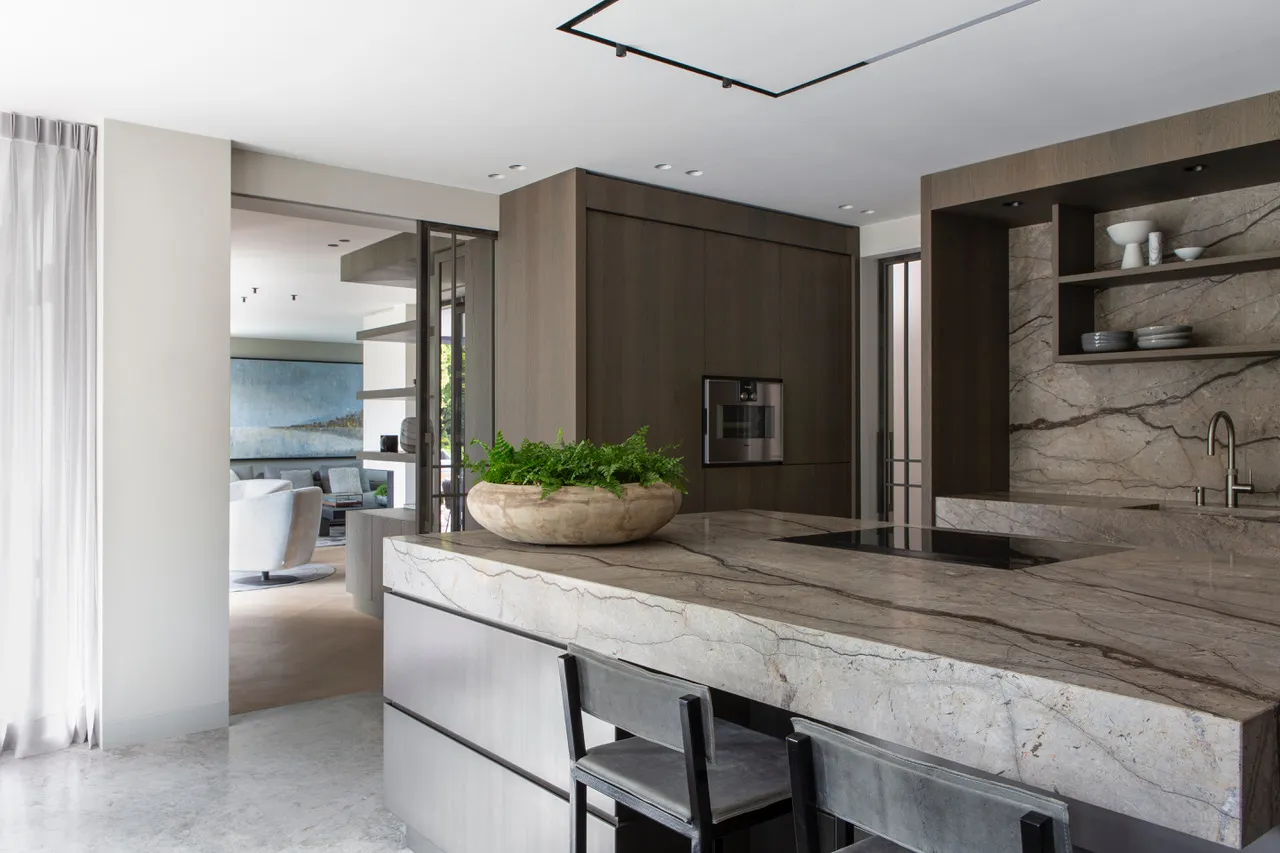
In the luxury segment, a kitchen is more than a functional space. It's the place where everyday life converges: breakfast with the children, a long dinner with friends, a quiet glass of wine at the end of the day. Every kitchen design begins with how you truly live. Whether it's a kitchen seamlessly integrated behind classic wall paneling in a Utrecht mansion, or a kitchen as a sculpture in the middle of a transformed warehouse: function and aesthetics are equally important.
Materials that stand the test of time
Utrecht has a rich artisanal tradition. As a trading city, it was a center of craftsmanship and quality for centuries. This tradition is reflected in the material choices I make for my projects.
Natural stone with its own unique character. Oak that ages gracefully. Bronze and copper that develop patina. Linen and wool that bring softness and warmth. Each material is chosen for its timeless quality, not for a passing trend.
The warmth of the handmade
In an age of mass production, the handmade holds a special value. A tiled floor laid by a master craftsman. A wall covering handwoven by a textile artist. A lighting fixture blown by a glass artist.
These elements give an interior its unique character, its soul. They cannot be replicated, cannot be copied. They belong to the space and to the people who live there.
Light and atmosphere in the Utrecht context
The light in Utrecht is different from that in Amsterdam or The Hague. The compact city center creates its own light patterns, the reflection of water on the Oudegracht gives the canal houses a special quality, and the green canal structure filters the light in its own unique way.
A well-thought-out lighting design is essential in every project. Layered, dimmable, tailored to the architecture and the way you use the space. From the bright light for a home office to the warm glow for an intimate dinner, from the dramatic illumination of an architectural detail to the soft background lighting that transforms a room in the evening.
Interior architect Utrecht versus interior designer
In the luxury segment, the distinction is essential. An interior designer can stylize a space. An interior architect fundamentally transforms it.
In Utrecht, with its large number of monumental and historically valuable buildings, this architectural knowledge is indispensable. Reading construction drawings, collaborating with structural engineers, designing structural interventions, and applying for permits from the municipality for monumental buildings: these are skills that make the difference between a cosmetic intervention and a true transformation. I'm familiar with Utrecht's regulations for protected cityscapes. I know which contractors have experience with historic buildings in the region. I have established relationships with specialized restorers who understand how to handle Utrecht's unique architectural styles.
The design process: from initial consultation to completion
Every project begins with a meeting. Not with a quote or a standard presentation, but with a conversation. You tell me about your lifestyle, your interior dreams, what works and what doesn't in your current situation. I listen, ask questions, and begin to understand.
Then comes the exploration of the building. I spend time in the space at different times of the day, studying the architecture, the construction, and the history of the building and renovation. I begin to see what's possible.
From there, the design develops in close collaboration. Concepts are presented and discussed. Material samples are assessed in the actual space. Details are refined until they're just right. Nothing is final until it feels right.
The realization phase requires meticulous coordination between all parties involved: contractors, craftspeople, suppliers, and artists. As an interior designer, I'm present at every step, from the initial demolition work to the very last finishing touch.
Utrecht deserves the best
Utrecht is a city with ambition and self-confidence. A city that cherishes its unique character yet is simultaneously open to innovation. This duality calls for interiors that embody the best of both worlds.
Interiors that are respectful of the building's history but add something new. Luxurious without being flashy. Timeless without being boring. Interiors that express who you are.
As an interior designer in Utrecht, it's my passion to create these spaces. By listening, observing, distilling down to the essence. By choosing quality over quantity. By creating space for silence—even in the dynamic, vibrant city that is Utrecht.
It starts with a conversation
Every special interior begins with a meeting. A moment when we get to know each other, you share your vision, and I listen to what you're looking for and what your home demands. The connection between interior designer and client is essential for a successful project. It requires mutual respect, shared ambitions, and the confidence that together we will create something special.

Remy Meijers is a renowned interior designer working in the luxury segment, both in the Netherlands and internationally. With his philosophy focused on "The Shape of Silence," he creates timeless interiors that blend materials, form, and light.